
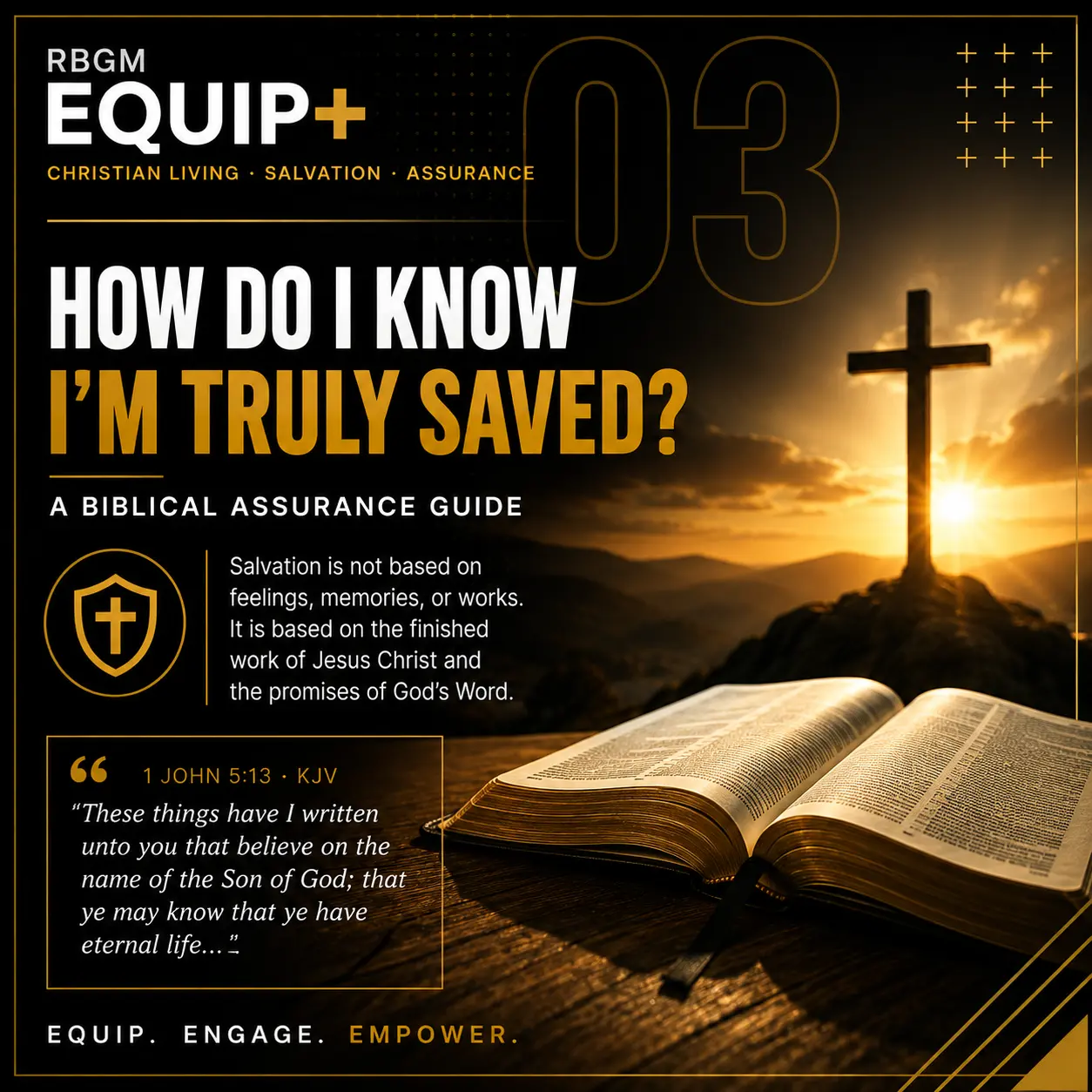
Christian Living · Salvation · Biblical Assurance
How Do I Know I’m Truly Saved?
Salvation is too important to base on a feeling, a memory, or someone else’s opinion. Scripture shows us where genuine assurance is found.
“These things have I written unto you that believe on the name of the Son of God; that ye may know that ye have eternal life...”1 John 5:13 · KJV
There are few questions more important than knowing where you stand with God. For some people, the question comes after years of being in church. You may remember praying a prayer when you were young, walking an aisle, being baptized, or having someone tell you that you were saved, but years later you find yourself wondering whether you really understood what you were doing. For others, the doubts come after salvation. You know you trusted Christ, but you expected to feel different all the time, and when those feelings are not there, you begin questioning everything.
The good news is that God does not ask us to base something as important as our salvation on a feeling, a memory, or another person’s opinion. He gave us His Word so that we can know.
That word ‘know’ matters. Biblical assurance is not convincing yourself that you are saved because you want to be. It is understanding what God says about salvation, examining what you are trusting, and resting in the promises He has given.
Start With the Gospel
Before we can answer, ‘Am I really saved?’ we need to be sure we understand what salvation actually is. The Bible begins with a truth that applies to every one of us: ‘For all have sinned, and come short of the glory of God;’ (Romans 3:23, KJV). Our problem is not simply that we have made a few mistakes or have not lived as well as we should. We are sinners before a holy God, and sin has a consequence.
Romans 6:23 tells us, ‘For the wages of sin is death; but the gift of God is eternal life through Jesus Christ our Lord.’ Notice the contrast. Sin has wages, something we have earned, but eternal life is a gift. We cannot erase our sin by becoming better people. Church attendance cannot save us. Baptism cannot save us. Growing up in a Christian family cannot save us, and neither can serving faithfully in a church.
God did for us what we could never do for ourselves. Jesus Christ died in our place, bearing the penalty for our sin, and rose again. Romans 5:8 says, ‘But God commendeth his love toward us, in that, while we were yet sinners, Christ died for us.’ Salvation begins by understanding our need and recognizing that Jesus Christ is the only One who can meet that need.
What Are You Trusting?
This is where the question becomes very personal. It is not enough to ask whether you believe in God, grew up believing in Jesus, or have always considered yourself a Christian. The real question is this: What are you trusting to make you right with God?
When the Philippian jailer asked Paul and Silas, ‘Sirs, what must I do to be saved?’ their answer was remarkably straightforward: ‘Believe on the Lord Jesus Christ, and thou shalt be saved...’ (Acts 16:30–31, KJV). Paul later explained that same truth in Ephesians 2:8–9: ‘For by grace are ye saved through faith; and that not of yourselves: it is the gift of God: Not of works, lest any man should boast.’
Our confidence must be in Christ, not in something we have done. There is an important difference between remembering that you prayed a prayer and knowing that you placed your faith in Jesus Christ. A prayer does not save us. Walking an aisle does not save us. Baptism does not save us. Jesus saves. When a sinner recognizes his need and turns to Christ in faith, trusting His finished work rather than his own works, God promises salvation.
What If I Do Not Remember the Exact Day?
This can be especially troubling for someone who trusted Christ as a child. Other Christians may be able to tell you the exact date, time, sermon, and even what they were wearing when they were saved. You may not remember nearly that much, and that can make you wonder whether your experience was genuine.
Scripture never makes remembering the date of your conversion a condition of salvation. A date written in the front of your Bible can be a wonderful reminder, but the date is not what saved you. Christ is.
Instead of trying to recover every detail of something that happened years ago, consider the more important question: What are you trusting today? If your hope of eternal life rests upon Jesus Christ and what He accomplished for you, your assurance should rest upon His promise rather than the strength of your memory.
Do Not Let Feelings Become Your Authority
Feelings can be convincing, but they are also terribly inconsistent. There will be days when you feel close to God and days when you do not. After a particularly convicting sermon, a failure in your Christian life, or a season when you have neglected prayer and Scripture, you may begin to wonder whether you were ever saved at all.
This is exactly why our feelings cannot be the final authority. Jesus said, ‘Verily, verily, I say unto you, He that believeth on me hath everlasting life’ (John 6:47, KJV). He did not say that the person who believes will always feel as though he has everlasting life. He said that he hath everlasting life.
A healthy Christian life will certainly involve conviction, joy, peace, sorrow over sin, and many other emotions, but none of those feelings are the foundation of salvation. God’s Word is. When your feelings and God’s promise seem to disagree, believe God.
But I Still Sin. Does That Mean I Am Not Saved?
Salvation does not make a Christian instantly sinless. In fact, John wrote to believers, ‘If we say that we have no sin, we deceive ourselves, and the truth is not in us’ (1 John 1:8, KJV). Christians still struggle with the flesh, make poor decisions, fall into temptation, and need to confess sin.
What changes is our relationship with sin. A believer should not be able to live comfortably in open rebellion against God without conviction. The Holy Spirit works within the believer, and as we grow in Christ, there should increasingly be a desire to obey God and a sensitivity when we do not.
That growth will not look identical in every Christian. Some mature quickly in certain areas and struggle for years in others. There may even be seasons of serious backsliding. The presence of a struggle does not automatically prove that someone is lost. In fact, sometimes the very struggle that worries a Christian is evidence that there is a spiritual battle taking place. The person who is grieved by his sin and desires to be right with God is in a very different position from someone who simply does not care what God says.
Should I See Evidence in My Life?
Works do not produce salvation, but genuine salvation should produce evidence over time. James wrote, ‘Even so faith, if it hath not works, is dead, being alone’ (James 2:17, KJV). James is not contradicting salvation by grace. Our works do not purchase eternal life or help Christ finish saving us. Rather, genuine faith has an effect on the person who believes.
As you grow, you may notice a greater desire to understand Scripture, a sensitivity toward sin that was not there before, a desire to pray, concern for people who do not know Christ, or a growing desire to live in a way that pleases God. There will still be failures, sometimes painful ones, but there should be evidence that God is working in your life.
We need to be careful here. If you spend every day inspecting yourself for enough evidence to prove you are saved, you can turn assurance into another form of works. The evidence is not the foundation of your salvation. Christ is the foundation. A changed life is the fruit, not the root.
What If the Doubts Keep Coming Back?
Some Christians struggle with assurance repeatedly. They hear a salvation message and wonder whether they need to be saved again. They remember a past sin and question everything. They pray another prayer ‘just in case,’ feel better temporarily, and then the doubts return.
If that describes you, repeatedly trying to recreate a salvation experience may actually make the problem worse. Instead, go back to what God has said. Do you understand that you are a sinner who cannot save yourself? Do you believe that Jesus Christ died for your sins and rose again? Have you placed your faith in Him rather than your own goodness, religion, baptism, or works? If so, then learn to rest in His promise.
Jesus said of those who belong to Him, ‘And I give unto them eternal life; and they shall never perish, neither shall any man pluck them out of my hand’ (John 10:28, KJV). Our security is not based upon our ability to hold tightly enough to Christ. It rests upon His ability to save and keep those who have trusted Him.
What If I Realize I Have Never Actually Trusted Christ?
Do not let pride, embarrassment, or years spent in church keep you from dealing honestly with God. It is possible to know the language of Christianity, attend church faithfully, be baptized, serve in ministry, and still realize that you have been depending upon something other than Christ.
If that is what you discover, you do not need to convince yourself that an earlier experience must have been salvation simply because you want it to have been. Come to Christ.
Romans 10:13 says, ‘For whosoever shall call upon the name of the Lord shall be saved.’ If you recognize that you are a sinner and understand that Jesus Christ died and rose again for your salvation, turn to Him in faith. Do not trust the words of a prayer. Do not trust an aisle you walked, a baptism you received, or a church you joined. Trust the Saviour those things were supposed to point you toward.
You Can Know
God does not want His children spending their lives wondering whether they are His. Assurance is not pretending that questions never arise, nor is it working yourself into a particular emotional state. It is learning to answer your doubts with the truth of God’s Word.
Your feelings will change. Your circumstances will change. Your Christian walk will have strong seasons and weak ones. You will have victories, and you will have failures. None of those things changes the promise God has made to the person who has placed his faith in Jesus Christ.
John wrote, ‘These things have I written unto you that believe on the name of the Son of God; that ye may know that ye have eternal life...’ (1 John 5:13, KJV). If you have trusted Jesus Christ as your Saviour, do not spend your life trying to find assurance by continually looking inward. Look to Christ. Remember what He accomplished for you, and believe what God has said.
Christ saves. His Word gives us reason to rest in that salvation.
Continue with RBGM